


Collective Performance
MANAGEMENT
1/30/20251 min read
In all organizations, we can “categorize” members into three groups: A, B, and C players. If we illustrate this with a basketball team, we have the Franchise Players, the other members of the starting five, and the players in the rotation, with the rest of the bench making up the final group.
Each of these groups has a role to play and is essential to the organization. Franchise Players cannot train without the rest of the team, and it is impossible to sustain an 82-game season plus playoffs without a complete roster capable of handling uncertainties. However, without top performers, a team cannot compete for a championship!
This vision can be fully transposed to the company! As managers, for the performance of the company, we will naturally tend to pay attention to the quality of recruitment, identification, training, well-being and motivation of our "A players" or our talents. This is legitimate and necessary, but we must not forget that the success and resilience of the company lie in the performance and quality of our "B players". A franchise player will be solicited and can be traded... (The news has shown us that no one is immune!)
This awareness of the need for B players to perform was sacralized by the words of Tony Parker at half-time against Spain: (at 1:10min https://youtu.be/nxKxHgwGogs)
To enhance business performance, it is crucial to focus on our B players by:
• Valuing them, training them, and addressing their expectation
• Accepting different ways of thinking and motivations
• Transforming our top performers into leaders, challenging them not only on their individual performance but especially on collective success
Go B players! Go teams!
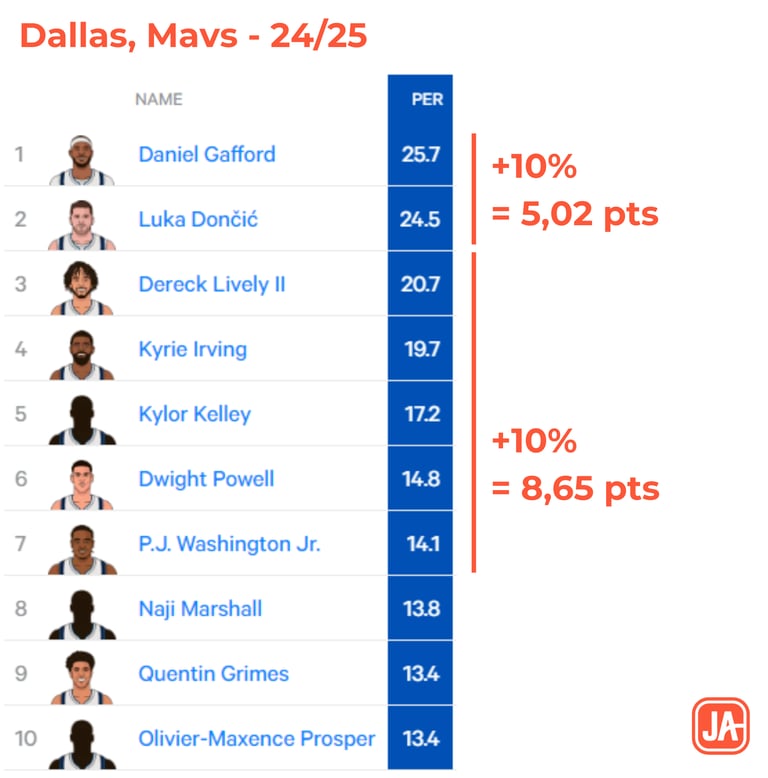
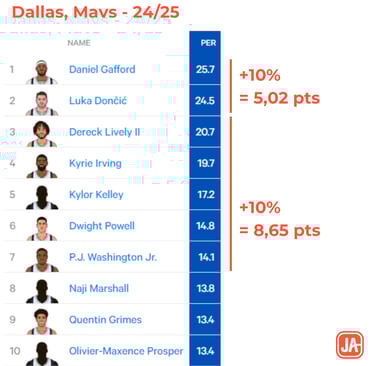
To continue the basketball illustration, it is statistically more interesting to work on improving the performance of B players than that of A's. Based on the Dallas Mavs' Player Efficiency Rating (PER) this season, a 10% improvement in Daniel Gafford and Luka Doncic's PER is equivalent to 5.02 points gained, while a 10% increase in the performance of the next 5 players is equivalent to an 8.65-point gain! Imagine the impact on larger organizations!!